AIDS, THE LOST VOICES


ICONIC: Ivan Cohen
Two men around 30, each with an HIV/AIDS diagnosis are on the same hospital ward. One is a patient and the other, a nurse. Both men were photographed with the late Diana, Princess of Wales as she opened the UK’s first HIV/AIDS ward at London’s Middlesex Hospital in 1987.
The patient on the ward only agreed to be photographed if he had his back to the camera in fear of being identified due to the rhetoric and stigma at the time. The nurse of the ward openly shared his HIV status with the waiting news cameras for the first time. But who were these courageous men, what happened to them and what impact did they have on HIV/AIDS stigma?

Shane Snape :NURSE

WRITTEN BY: Pearl Dreier, Ivan’s Sister
IVAN Anthony Cohen was born June 1955 to parents, Freddy and Helen Cohen in a small town in South Africa.
His parents were two very interesting and inspiring people, taking great joy in the talents of their three children ( including his sole surviving family member, Pearl Dreier). Freddy and Helen met on a ship to South Africa in 1953. Freddy was South African and Helen was English. He was returning home and she was visiting her cousin, the well known Jazz pianist, David Lee.
Their relationship progressed quickly thereafter with Helen immigrating to South Africa with her dad, Harry Green in tow. She was only 20 and Freddy was 31. The family were all entrepreneurial , with Freddy owning a number of wholesale businesses and hotels. Harry, the cockney, lived with the Cohen’s until the end of his life at 83. A real “character“ he was, having been a successful book maker and earlier a bantamweight boxing champ.
Ivan was an intriguing person from early on. Very artistic and interesting. He loved to socialise but unfortunately, being gay, held him back from spreading his wings and truly being himself. He left South Africa in 1975 for the UK, unfortunately coinciding with both father and grandfather’s passing.


He did however find his wings, loving London and all it had to offer, successfully running his own business as a graphic artist with a keen interest in everything the UK had to offer.
He never revealed his life as a gay man to his parents, and on the last visit with his mum and sister it was quite clear in 1987 that he was afflicted with HIV. His mum never discussed his health before passing away in January 1987. The family took small comfort that she pre deceased Ivan by 6 months, thereby avoiding the notoriety his handshake with Princess Diana caused.
APOLOGY
October 2025
Ivan’s sister responded to my earlier messages in October 2025 and pointed out several inaccuracies in Ivan’s biography. Pearl kindly agreed to share insight into her brother’s life, clarifying dates, relationships and life events that had been misreported, and I express my sincere apologies for any distress my research may have caused. Pearl’s contribution has been invaluable, and I am grateful for her patience and willingness to help ensure Ivan’s story is recorded with greater care and respect.

PROBATE: Granted December 1987
It is often considered vulgar to speak of money or personal wealth, yet doing so can expose a deeper truth: during the height of the HIV/AIDS crisis the presence of wealth, professional status or comfortable domestic trappings punctured the myth that the epidemic was confined to a single, homogenous group.
Ivan was a graphic designer in the 1980s; when probate was granted in December 1987 his personal estate was valued at £157,044.00p (equivalent to £437,483.79p as of March 2024), largely realised through the sale of his three‑bedroom flat at 6 Biddulph Mansions, Elgin Avenue, London, W9. The scale of his estate — comfortable and respectable for the time — serves as a stark counterpoint to the stereotyped narratives the British press circulated about HIV/AIDS victims, underscoring that disease did not discriminate by talent, social standing or material success. In Ivan’s case, financial stability and professional reputation offered no immunity, reminding us that illness cut across the neat categories society tried to impose and demanding a more humane, less sensational response than the headlines allowed.

CLICK TO ENLARGE (OPENS IN NEW WINDOW)



UPDATE: 1 December 2025 (World AIDS Day)
With each person we research and feature we always turn to the UK AIDS Memorial Quilt to see if they have been memorialised and whether that panel holds clues or details to their life. When the UK AIDS Quilt went on display in its entirety at the Tate Modern in 2025 and quietly announced it was accepting new panels, Ivan was at the top of my list.
The quilts are typically made by family, loved ones, partners and friends — none of which I was — but my research into these lives has, in a way, allowed me to dedicate a panel on their behalf; there has never been, and still is not, a limit on how many panels can be created for a single person, therefore I am not taking the opportunity to usurp a space meant for kin. Crafting a quilt for Ivan felt less like overstepping and more like completing a necessary piece of the record: a tangible acknowledgement that his life, like so many others, mattered and can be seen.
When Ivan’s sister Pearl followed up on our podcast, I had already begun crafting Ivan’s quilt: meticulous hand-stitched diamantes arranged into a radiant sunbeam that catches both artificial and natural light, its brilliance heightened by a subtle adjustment of Ivan shaking the hand of the princess. That photographic tilt draws the eye to the handshake between Ivan and the late Princess Diana—a single, searing moment captured in an image that made the world stop and think—while the quilt’s shimmering ray frames the gesture, honouring its quiet significance and the way an intimate touch can reverberate through history.
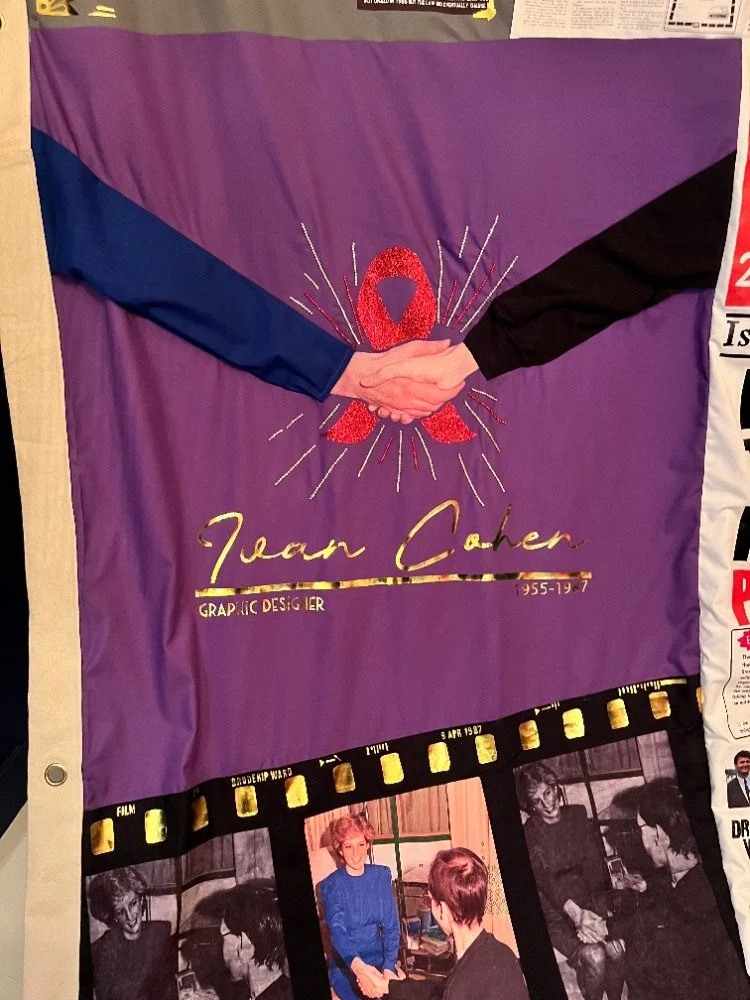
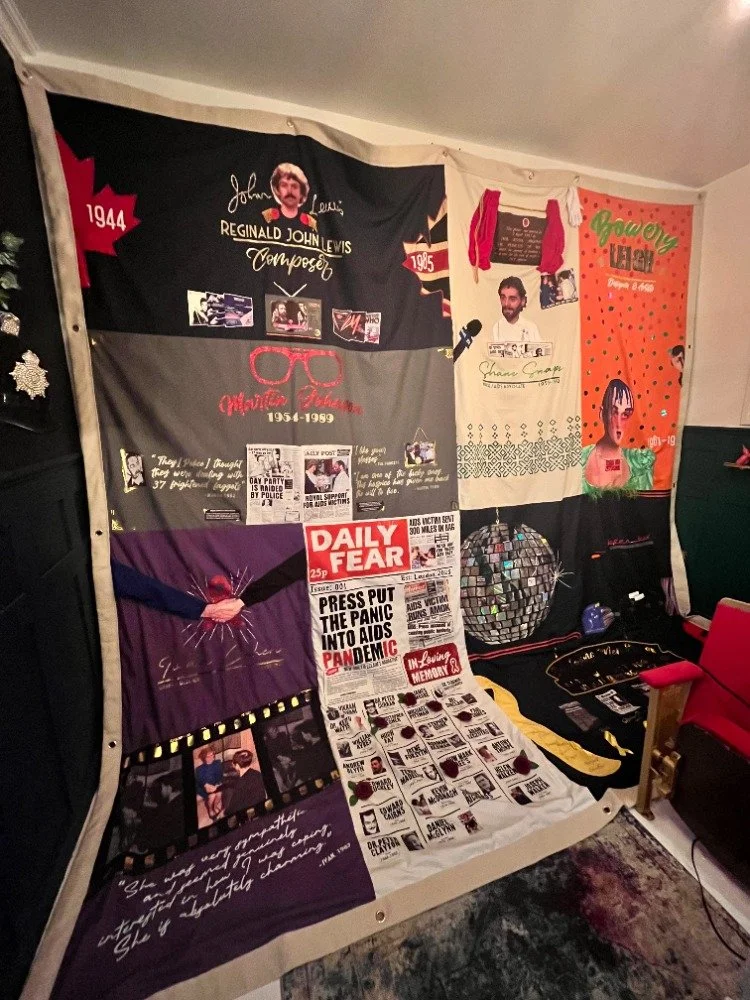
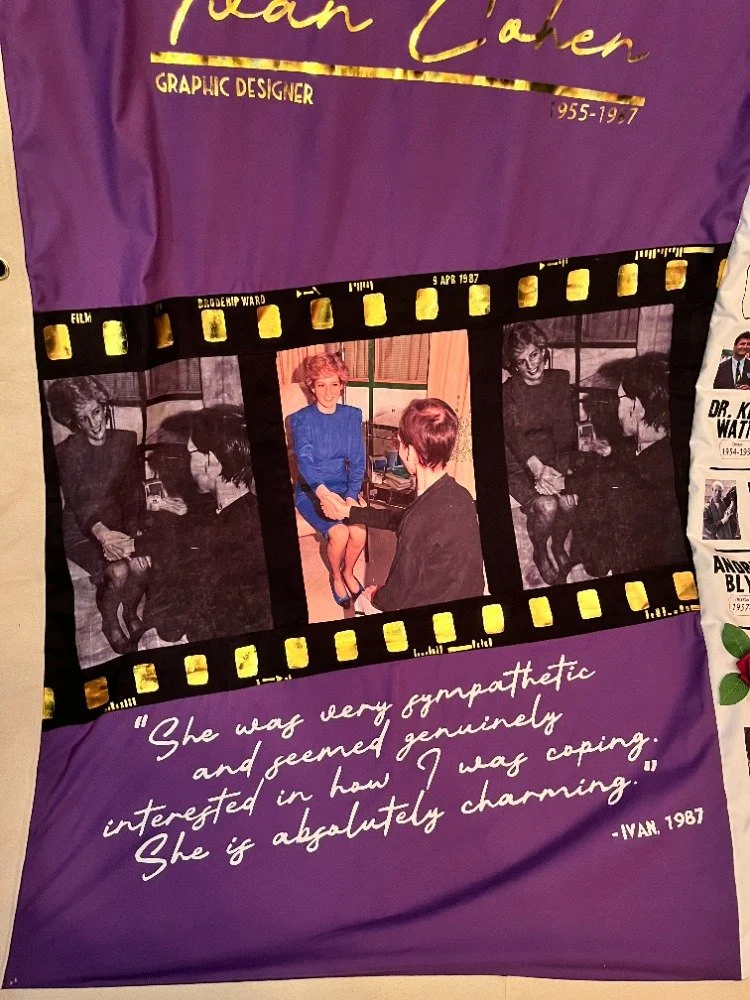
In a bid to ensure I didn't cause any unnecessary upset, I shared some of the above images as all eight quilts were finally being stitched together to form one 12 ft by 12 ft quilt, ready for display with Ivan’s sister, Pearl. Thankfully Pearl and the family had no objections to Ivan’s quilt being included; his courage in sitting for the photograph, preserved alongside the others, will continue to remind and educate viewers about the prejudice faced and the enduring harm of HIV/AIDS stigma. As the assembled quilts are shown together, they stand as a collective testament to lives lived and lost, urging us to resist letting stigma — whether attached to HIV/AIDS or any future virus — take hold again.


SHANE Christopher Snape was born Burnley, Lancashire in October 1959. The second of two sons to parents John and Norma Snape, Shane the youngest by 5 years to Leslie Snape.
After qualifying as a nurse in Lancashire Shane worked on a psychiatric ward at the mental health facility Calderstones Hospital, Lancashire.
Upon moving to London Shane was instrumental in being on the team commissioned to open the UK’s first dedicated AIDS Ward. Living with the disease Shane advised other care facilities on nursing care.
For what was to be the final 4 years of his life Shane worked as a training officer for the Department of AIDS Education in the North West Thames region. Shane passed away on 20 March 1992 at the Mildmay Hospital, Tower Hamlets, London.

THATCHER: Shane 3 Aug 1989


ABOVE: Shane & the Princess
LEFT: Bed on the Broderip Ward, 1987
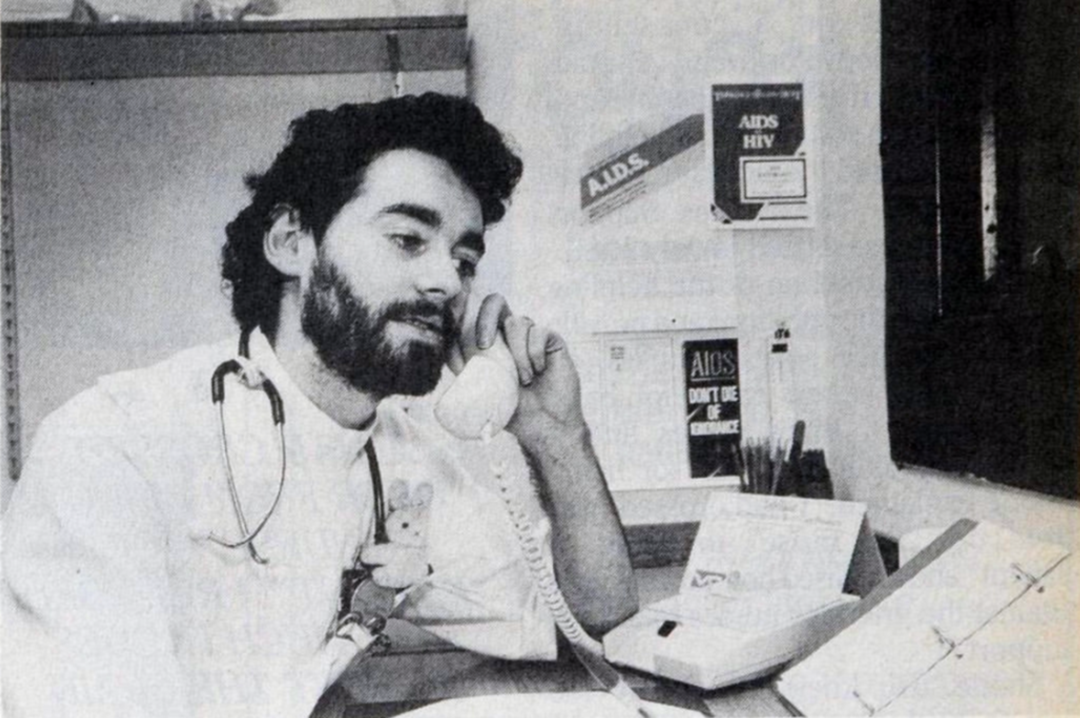
Shane Snape: Running an AIDS helpline especially for nurses (c.1987)
CLICK TO ENLARGE (OPENS IN NEW WINDOW)


UPDATE: 1 December 2025 (World AIDS Day)
I was surprised Shane Snape was also absent from the UK AIDS Memorial Quilt, and my heart was set on dedicating a panel in his memory: his tireless work as a state nurse was instrumental in establishing and working the UK’s first dedicated AIDS ward, the Broderip Ward at London’s Middlesex Hospital, and his quiet courage and relentless advocacy for people living with HIV and AIDS changed countless lives.
He ran the AIDS helpline for nurses, supporting colleagues who faced stigma and prejudice even within a profession that should have known better, and he never stopped pushing for compassionate care, better information and the protection of those most vulnerable; to exclude him from the Quilt felt like a denial of a vital chapter in our history and a call to ensure his contribution is remembered and honoured not only as someone who worked the AIDS wards, helplines and advocacy but as a man who lived with HIV himself and who succumbed to AIDS in 1992.
Photo: The quilt was suspended in my cramped home, laid flat or hung straight it does not present a ‘wonky’ perspective.
Any third-party copyright material has been accessed through paid membership or incurred an administrative cost. Material has been used under the ‘fair use’ policy for the purpose of research, criticism and/or education, especially around the topic of HIV/AIDS. There has been no financial/commercial gain.